
Sometimes in My Dreams
One Hundred and Forty-Four Thousand

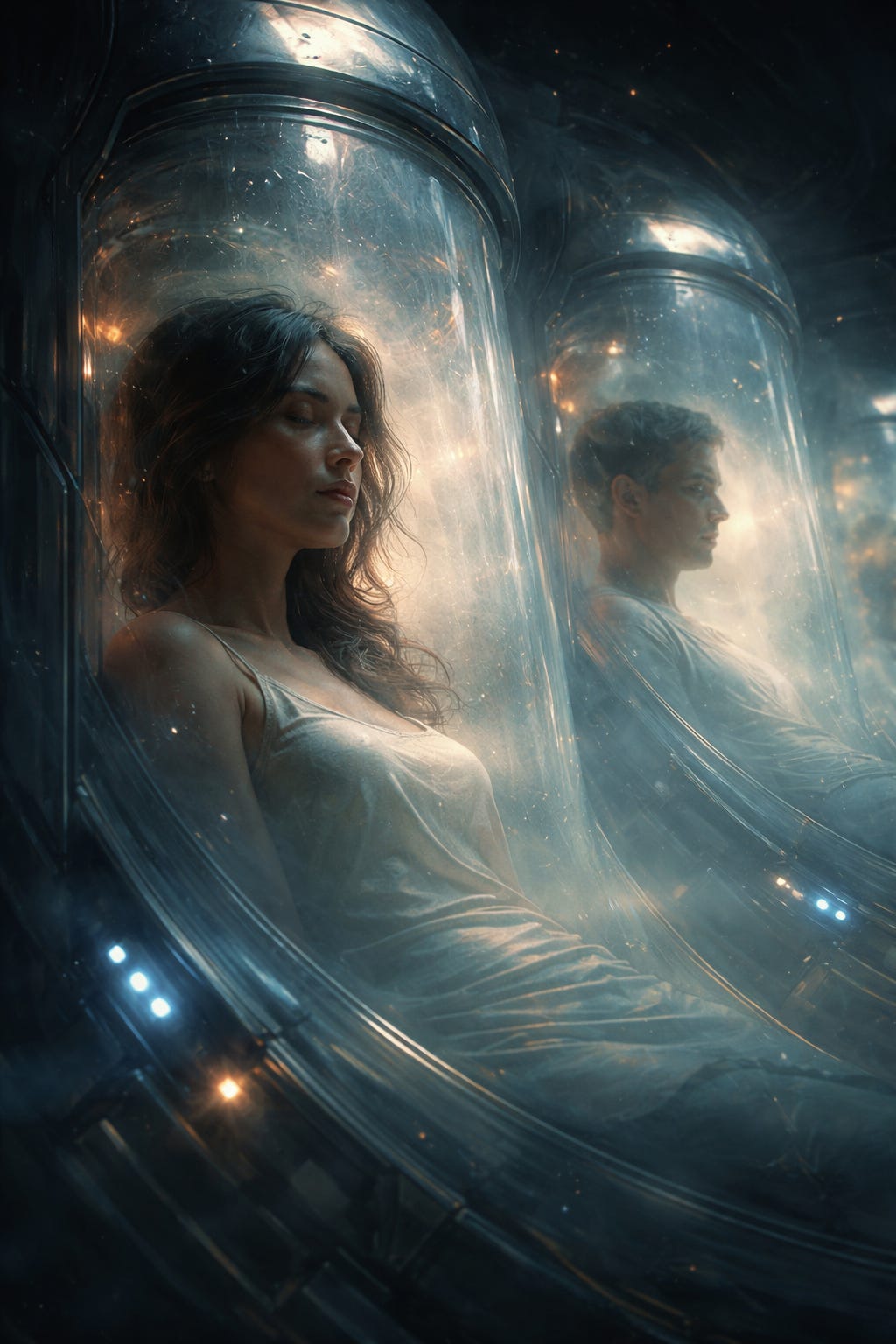
The bar kept its own kind of time.
Glasses were washed, dried, and set back in their places. Bottles turned just enough that their labels faced forward. The same low hum of conversation rose and fell each night, as if rehearsed. Even the pauses felt familiar—like breaths taken in unison by people who didn’t know they were doing it.
He had worked there long enough to stop measuring the days.
Not because they blurred, exactly.
Because they repeated—almost.
She stepped in just after the lull, when the room reset itself.
Not late. Not early. Precisely when someone like her would arrive.
He noticed her before she reached the bar. Not in the way a bartender notices a new customer, but in the way a thought returns—uninvited, but not unwelcome.
When she looked up, it settled into place—the colour of her eyes, the shape of her smile.
Not recognition, exactly. Something older than that.
A feeling he’d had before, though he couldn’t say when.
As if he were not meeting her, but remembering her.
He set a glass down in front of her.
“The usual?” he asked.
She paused, one hand resting lightly on the bar.
“I think you have me confused with someone else.”
“Probably,” he said.
He didn’t move the glass.
She glanced at it, then back at him. “What is it?”
He hesitated, just briefly. “You switched to whiskey.”
“I don’t drink whiskey.”
A small nod, as if confirming something to himself. “Right.”
He reached for the glass, but not quickly. Not like it was a mistake—more like a correction.
“Surprise me,” she said, settling onto the stool.
“That happens more often than you’d think.”
“I doubt that.”
He smiled faintly and turned away, selecting something without looking too closely. His hands moved with a familiarity that wasn’t quite habit. As if the motion had been practiced elsewhere.
When he returned, she was watching him—not curiously, but with a quiet concentration.
She looked at the glass, as if the answer might be written there. “Is it a Manhattan?”
“Close,” he said. “Not quite, though.”
She smiled. “You’re almost good at this.”
“I usually am.”
“Usually?”
He met her eyes. “With you, I tend to be.”
She held his gaze a moment longer than necessary.
“Have we met before?” she asked.
“Yes,” he said. “And no.”
She gave a small laugh. “That’s not an answer.”
“I think I’ve met someone like you,” he said. “Not you exactly—but close enough that it feels like we’re continuing something we already started.”
“Funny,” she said. “I was about to say the same thing.”
He leaned lightly against the bar.
“There’s a theory I’ve been working on,” he said. “Do you want to hear it?”
“Alright,” she said. “You have my attention.”
“Have you ever heard of the one hundred and forty-four thousand?”
“From the Bible?”
“Something like that. A fixed number. A closed system.”
She tilted her head. “Go on.”
“A small group,” he continued. “Enough to sustain a population. At least in theory.
Sent somewhere new. Or meant to be.”
“That sounds intentional,” she said.
“It was supposed to be,” he said. “Except something goes wrong. We don’t reproduce. We don’t die either.”
“So what happens?” she asked.
“We stay,” he said. “Or think we do. Long enough that the rest starts to… fill itself in.”
He glanced at her.
“Cryochambers, maybe. A long sleep we mistake for a life.”
“That sounds inconvenient.”
“At first,” he said. “Then… imaginative.”
Her smile returned. “Imaginative how?”
“We start filling in the gaps,” he said. “Children we’ll never have. Lives we’ll never live. Versions of ourselves that branch off, multiply… evolve.”
“Doppelgängers,” she said.
“More than that. Entire histories. Enough detail that they begin to feel real. Enough repetition that we start to recognize each other inside them.”
“And that’s what this is?” she asked. “Recognition?”
“Something like it,” he said. “Not memory, exactly.”
“Then what?”
He considered that.
“Memory without the experience,” he said. “Or maybe the experience happened somewhere else.”
She nodded slowly, absorbing it.
“And this?” she asked. “What is this life?”
He looked at her, not searching this time—certain.
“An unlived experience.”
That seemed to settle somewhere between them.
“That’s sad,” she said.
“Yeah,” he agreed. “But at least we’re not alone.”
A faint smile touched her lips. Not amusement—something closer to recognition.
“We do seem to keep finding each other,” he said. “Eventually.”
She studied him, searching for something that felt just out of reach. Not a memory—something adjacent to it.
“Do we?” she asked.
He picked up a glass, turned it once in his hand, and set it back down in exactly the same place it had been before.
“Not like this,” he said.
“Then how? When?”
He met her eyes, steady and certain in a way that didn’t quite match the moment.
“Sometimes in my dreams,” he said.
“Am I?” she asked.
He smiled.
“Almost always.”
I like how this story creates a cocoon for the characters that also pulls in the reader.