
Strongly Worded Letters

A protest rages outside a neighbourhood café while three friends argue about power, freedom, and the limits of polite resistance. Between espresso steam and police sirens, conviction collides with cynicism—and the uncomfortable possibility that the system no longer needs to silence dissent, only to exhaust it.
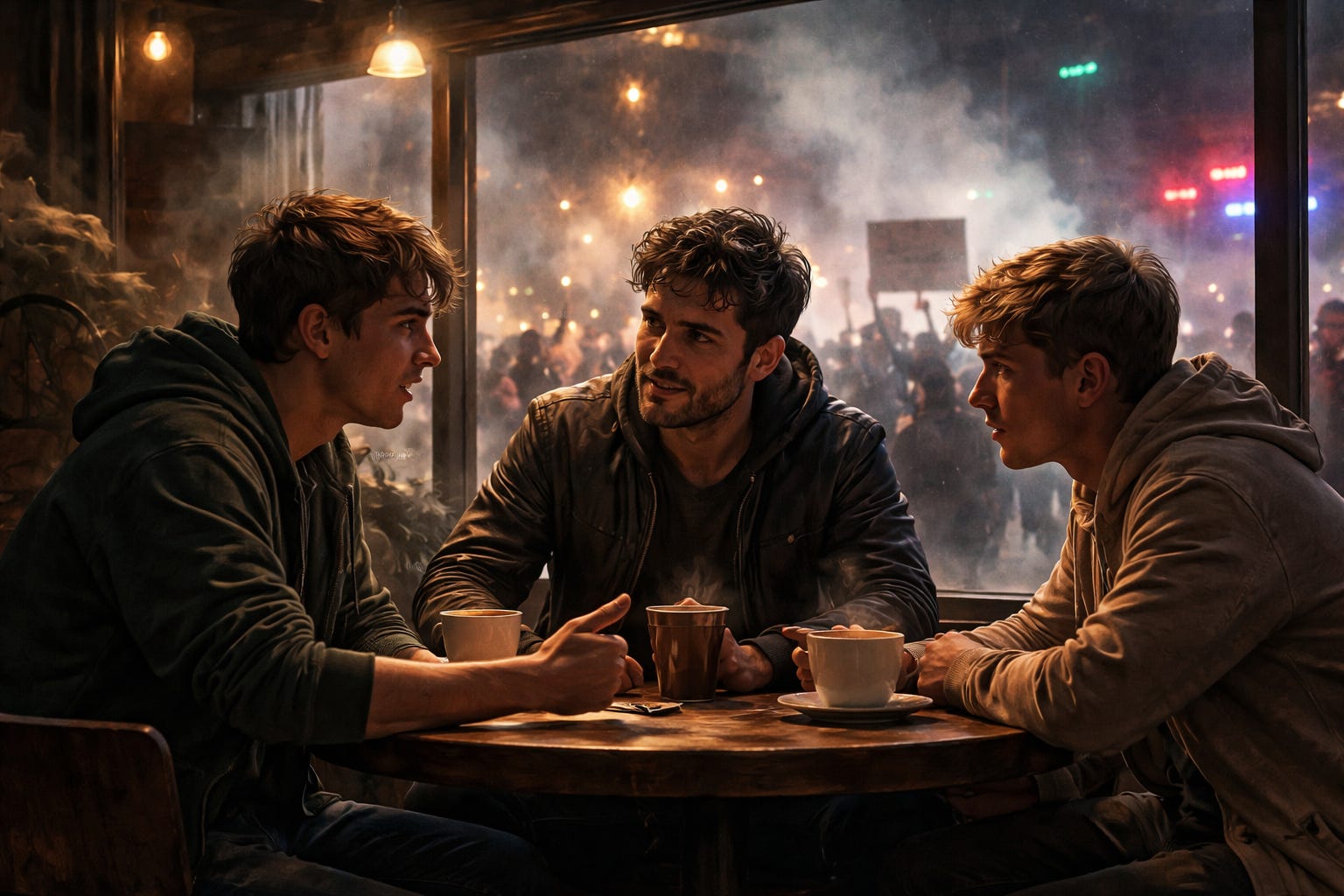
The café sat on the corner like a neutral zone—locally owned, warmly lit, pretending not to notice the world unravelling just outside its windows.
Inside, the air smelled of espresso and scorched milk. Indie folk music hummed softly overhead. Outside, a crowd surged through the streets, chants ricocheting off concrete towers. Police lights strobed blue and red against the glass. Somewhere nearby, something burned. Smoke drifted in every time the door opened.
Eli leaned forward, eyes bright with urgency, fingers wrapped tight around his coffee cup.
“I’m going to write a strongly worded letter. They can’t kill us and get away with it!”
Marcus stirred his coffee slowly, not looking up.
“Ooh! Dem’s fighting words! They might even get a proper paper cut.”
Eli scowled.
“Mock me, but we’re protesting in the streets.”
Marcus glanced toward the window, where a chant rose and collapsed like a wave hitting a seawall.
“And where did that get you? Have you seen any substantial changes?”
“Oh, just wait and see! In one year’s time there’ll be changes.”
“You’re assuming martial law won’t be declared.”
“They wouldn’t.”
Marcus set his spoon down. The clink rang louder than it should have.
“They’ve killed, illegally detained, kidnapped, and rigged the voting system. They’ve got all three levels of government hog-tied. Criminals are running the show, and you think writing strongly worded letters and protesting is going to make a difference?”
A barista glanced over, then quickly looked away.
“The fascists took over while you were sleepwalking. When was the last time you had to fight to defend yourself? Look, I get it. It’s not like you have any real options. You’ve got yahoos on the right happy to embrace fascism and yahoos on the left happy to embrace managerialism. Democracy is dead.”
Eli opened his mouth, but Marcus plowed on.
“The ‘will of the people’ has been so thoroughly cajoled with a constant diet of bullshit that they still believe they have rights after giving them away. Every time they ‘voted,’ they relinquished more power to their elected representatives. They took the farm out from under you while telling you they’d protect your interests.”
Outside, a drumbeat faltered.
“‘Don’t worry,’ they said, ‘we’ll protect you.’ And so they started building camps to house you in. They gave you extra rations and privileges when you behaved. They punished everyone whenever anyone stepped out of line. Just like good Pavlovians, you came to despise your own people. They got you cheering for their punishment—even their death—and made you believe they were the cause of your suffering.”
Eli shook his head.
“What are you talking about? We haven’t gone that far.”
Marcus smiled thinly.
“No, you’re right. Of course you’re right! If a law enforcement agent shoots you dead, you’ll still get your day in court. Who was it—Machiavelli, Robespierre, Hitler, Stalin, Mao Zedong—I can’t remember—who said the dead can’t speak?”
The café felt smaller now.
“Somehow this got spun around and everyone became afraid of standing up. So much so that they accepted the worst cruelties by thugs. They even fed you the line ‘the meek shall inherit the Earth.’ A beautiful piece of propaganda.”
Jonah shifted in his chair, finally speaking.
“Don’t talk about such things. Talk about the weather. People are looking. We shouldn’t be having these discussions out in public. We should leave these discussions to the media.”
Marcus stared at him.
“But so much is happening. None of it good. When do we get to talk about these things?”
Jonah shrugged, eyes on his cup.
“I wouldn’t if I were you, anybody could be listening.”
“But they don’t go into any depth,” Eli said, gesturing toward the window. “They skim over everything. I watched a murder reported under an entertainment channel.”
Marcus laughed once—sharp, humourless.
“Freedom of speech is a ruse. They’re laughing, saying, ‘Let them talk all they want. Let them talk themselves in circles.’ It’s action that’s constrained.”
He leaned back.
“‘Give me your freedom,’ they say—and in whispers behind your back add, ‘and I’ll give you a jail cell and call it liberty.’ Your right to act will be replaced with laws telling you what you can and cannot do—for your own good. Always for your own good.”
Outside, sirens wailed.
“Enough of you are fed. You have housing. Your quality of life is good enough that there’s no reason to complain. That’s the rub. You’re victims of your own complacency. Keep the entertainment industry rolling. Distract you with fashion and trends. And you want to negotiate for more? A higher minimum wage? Another holiday?”
He paused.
“All it took was catering to your greed to buy your silence.”
Then, almost ceremonially, he recited:
You are never more free than when you are willing to sacrifice everything.
You are never more free than when you have nothing left to lose.
You are never more free than when you are no longer afraid of the consequences of your actions.
You are never more free than when you accept that your death is inevitable.
You are never more free than when there is nothing anyone can take from you that will stop you from doing what you believe is right.
Marcus broke into laughter.
“Lord, the rabble are rousing.”
He straightened, adopting a dignified tone.
“Then set not a flame to their passions. Lower the price of spirits. Reduce the taxes on their indulgences.”
The humour drained from his face.
“The first time you take a life it’s rough, but it gets easier. You’re taught that violence is wrong, but these are violent times. Let your morality be your guide.”
Eli swallowed.
“We’re tackling the housing problem. We’re putting up tent cities.”
Marcus nodded.
“The poor are defecating in the streets, so we’ve installed pay-for-use public toilets. Surely the poor have at least a dollar to pay to shit.”
A fist pounded on the café door. Someone outside shouted for water. No one moved.
Inside, the coffee cooled. Outside, the smoke thickened. The glass held—for now.
Felt like I was sitting in a café in Minneapolis. Strange days indeed.
Wow great read! Feels as though this is a real conversation happening somewhere in the world right now. One of those timeless conversations captured beautifully.