
THE GREAT BANKRUPTCY
What if you were born into debt—and spent your life trying to pay it off?

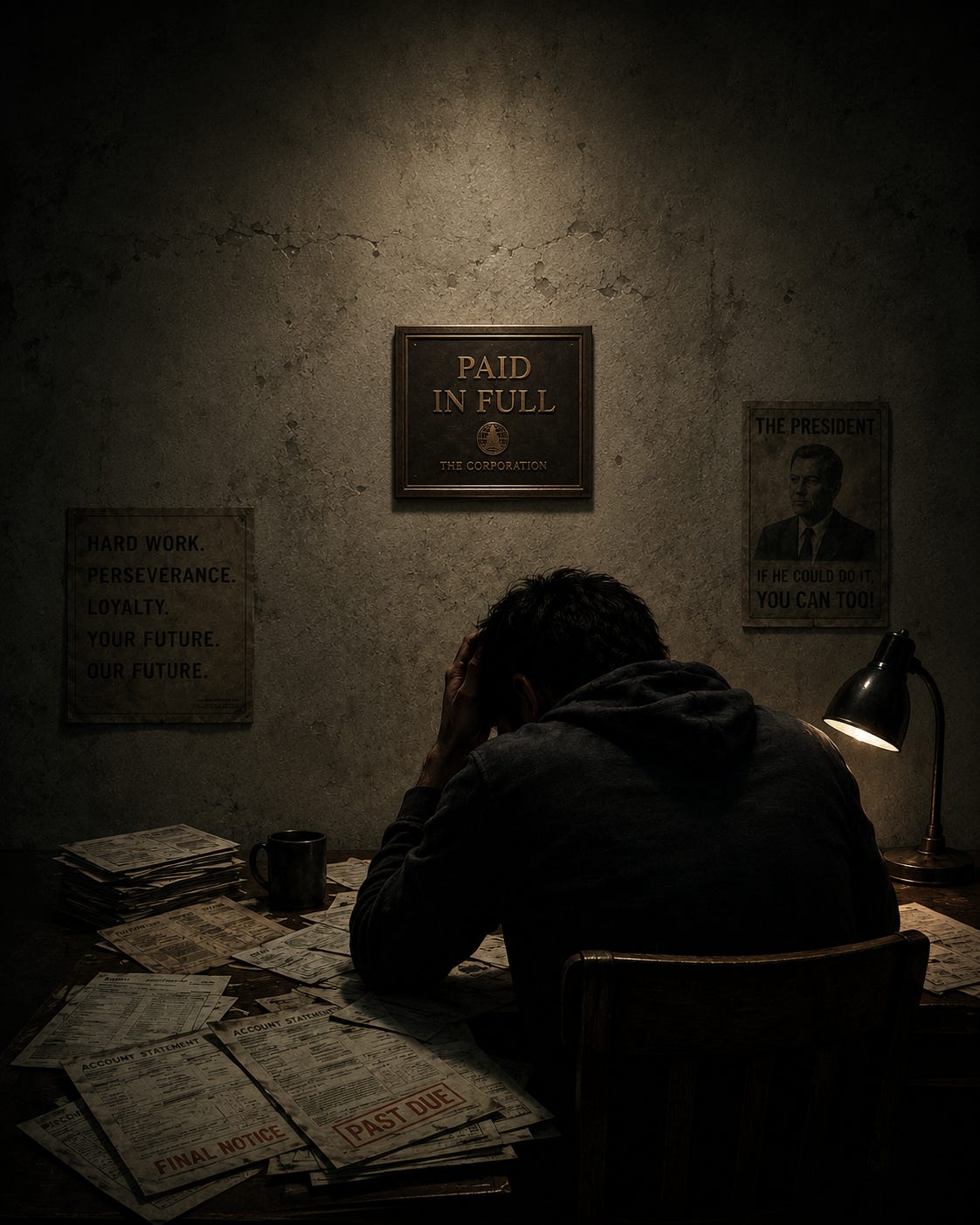
It was a cold Monday night, and the radio in the cafeteria said it was going to snow.
Snow.
I don’t remember the last time I saw snow.
It doesn’t snow in the city anymore. Not really. The towers give off too much heat—something about atmospheric control systems, the scientists say. A kind of thermal umbrella. The snow melts before it reaches the ground.
When they say it’ll snow, what they mean is: we get rain, and they get snow.
If you were to talk to my mom, she’d deny any talk of us and them. She’d say we’re all in it together. That it was excessive waste that got us here, and that everyone has their fair share of the burden to carry.
My name is Alfredo Magellan. I was supposed to start college when I was seventeen. I had a scholarship. Then my dad died of a heart attack.
Do you know anything about the Great Bankruptcy?
Most people don’t. Or they say they don’t.
My mom says it happened early in the twenty-first century. The world was in debt—to the banks, of course—and one year they just called it in. Foreclosed on everything. Countries included.
After that, there weren’t any countries. Just the Corporation.
It’s run by a board of directors pulled from the major banks. They call it the most democratic system ever devised.
Every citizen is assigned a share of the global debt. You inherit it at birth. Your parents make the minimum payments until you’re old enough to take it on yourself.
It’s efficient. It solved the population problem—people stopped having kids they couldn’t afford.
The rich, of course, had no such concerns. They paid off their debts early. They live on the outskirts. They’re the ones who get snow.
We’re told that once you pay off your debt, you receive a plaque—Paid in Full. Then you’re free to buy shares in the Corporation.
What they don’t tell you is that the debt compounds. Daily. Most people never get close to paying it off. They just keep up with the minimums and call it living.
And all the while, they remind us how free we are.
Take the President, for example. They tell us how he worked double and triple shifts in a factory, fueled by caffeine and ambition, saving every cent until he paid off not only his own debt, but his parents’ as well. Put himself through college, too.
If he could do it: YOU CAN TOO!
I don’t believe it. Not on minimum wage.
But my parents did. They ate it up.
Hard work. Perseverance. Higher education.
Only a few can afford higher education, so for most of us, that leaves hard work and perseverance.
People like my parents believe in it. If not for themselves, then for their children. They want to believe the reward comes eventually. Just not in their lifetime.
I’m not willing to wait that long.
I’m not a martyr.
My dad was.
He died at fifty-five, and the first thing I felt when they told me was anger.
The vice-principal pulled me out of class. Told me my father had been a model worker. He waited until the end of his shift to die.
A model worker.
What about a model father?
How could he leave us like that?
Leave me and my mom with the responsibility of carrying my younger twin brother and sister—Prospero and Teresa—and their debt?
He knew I had a scholarship. He knew how hard I’d worked for it.
Why now?
But before those thoughts could become anything more—before they could turn into something dangerous—I buried them.
Along with him.
Alice, the foreman at the factory where my parents worked, offered me my dad’s position. I couldn’t afford to refuse.
My mom got a small payout from his pension. Enough for the cremation, the service, and the death tax—which, at least, cleared his remaining debt.
We didn’t fall further behind.
I have a lot of respect for my mom.
A friend had agreed to switch shifts to enable her to go to Dad’s funeral. She cried during the ceremony, said her farewells, and then went in to work.
Your life changes as suddenly as a light going out.
After my first year at the factory, I was working twelve-hour days. Most days longer.
My mom seemed to age a lot faster after Dad’s death, and she could only manage a twelve-hour day, five days a week. She would tell me that all our troubles wouldn’t last forever, just until Prospero and Teresa could assume their debts. Four years had passed, and I counted every day, waiting for them to graduate from the secondary level.
It was raining hard when I left work that Monday night, and I hadn’t brought an umbrella with me, so by the time I got home I was drenched. As I walked through the kitchen door of our meager apartment, there were Prospero and Teresa grinning from ear to ear.
“What’s with them?” I asked my mom.
“Come sit down and have your coffee. You two, go into the other room. I want to talk to your brother in private.”
They both ran out of the kitchen excitedly. She poured us both a cup of coffee, put a tin of biscuits in the center of the table, and then sat down with me.
“Your brother and sister have been accepted to college. Their marks weren’t good enough for a scholarship, but at least they’ve been accepted.”
There it was.
“We can’t afford it,” I said, hitting the table, rattling the cups in their saucers and spilling our coffees.
“Alfredo,” she said in a low, calm voice, “you’re being unreasonable.”
“Unreasonable?”
“Yes. Your father and I wanted very much to send all of you to college, and I’m sorry that his death was untimely for you, but you should be grateful for everything that we were able to give you instead of always complaining.”
“Mom, I am grateful to you and Dad. But this—this isn’t right. We’re not free. We’re just… managing debt.”
“Where’s that kind of thinking going to get you? We are a family. Do you think that your father and I thought twice about having you children? No. No amount of debt would have stopped us from having you, even when the lady from Human Resources told us that it wasn’t a financially sound venture with our income to have a child, let alone three. Your father…”
Her voice faltered.
After all this time, it was still torture for her to talk about Dad. We are all the family she has left.
“Okay,” I said. “Maybe if one of them would agree to come and work at the factory, we might be able to send the other.”
Mom was silent, staring at the swirls she made in her coffee. Each time she stirred, the spoon tapped against the ceramic cup with a flat, hollow sound. With a breath, she drew herself back and said, “We have my pension.”
“We can’t use your pension.”
“It’s my pension.”
“But, Mom, what if something happens? What if you get sick? I can’t carry everyone’s financial responsibilities on my own.”
“I know that we have all asked a lot of you since your father died, but he worked himself into his grave so that you could all have the opportunities that he never had. He would have been very proud of you, taking care of your brother and sister the way that you have. It’s only for another four more years. Then they’ll be able to assume their financial responsibilities, and with their degrees they’ll be able to earn good money. Then you’ll be able to take it easier, not work as hard, and take a couple of those classes you’ve been wanting to.”
“Do you know when I last saw snow?” I asked her. “Touched it, felt it melt when the feathery flakes landed on my face as I watched it drift down from the sky? It was on a school trip when I was a kid. They took us on a bus ride and showed us all the lovely homes on the outskirts of the city with their Christmas decorations and lights all lit up.”
My mom just looked at me, not knowing if I had heard a word that she had said, and a little afraid to ask. She cringes sometimes, almost imperceptibly, but I notice it. She never used to when Dad was alive.
Don’t you see? This is the world that they’ve created. I don’t hate my mom. I don’t hate my dad. I don’t blame them, and I don’t blame my brother or sister for wanting a good education. It’s the only way out. Don’t they think that I know that?
We’re all products of the same system—supply and demand, the free market.
Go ahead. You tell me who I should blame.
Right.
We’re all in it together.
The doctor sat alone in his office with only a desk lamp on to illuminate a small working area. His chair creaked as he leaned forward and turned off the tape recorder. He picked up the pen and, in blue ink on a piece of white paper beside the typed name of Alfredo Magellan, rendered his diagnosis:
paranoid schizophrenic.